Affordable Housing Perseveres in Maui, Anchoring Wildfire Recovery

By Mark Fogarty
8 min read
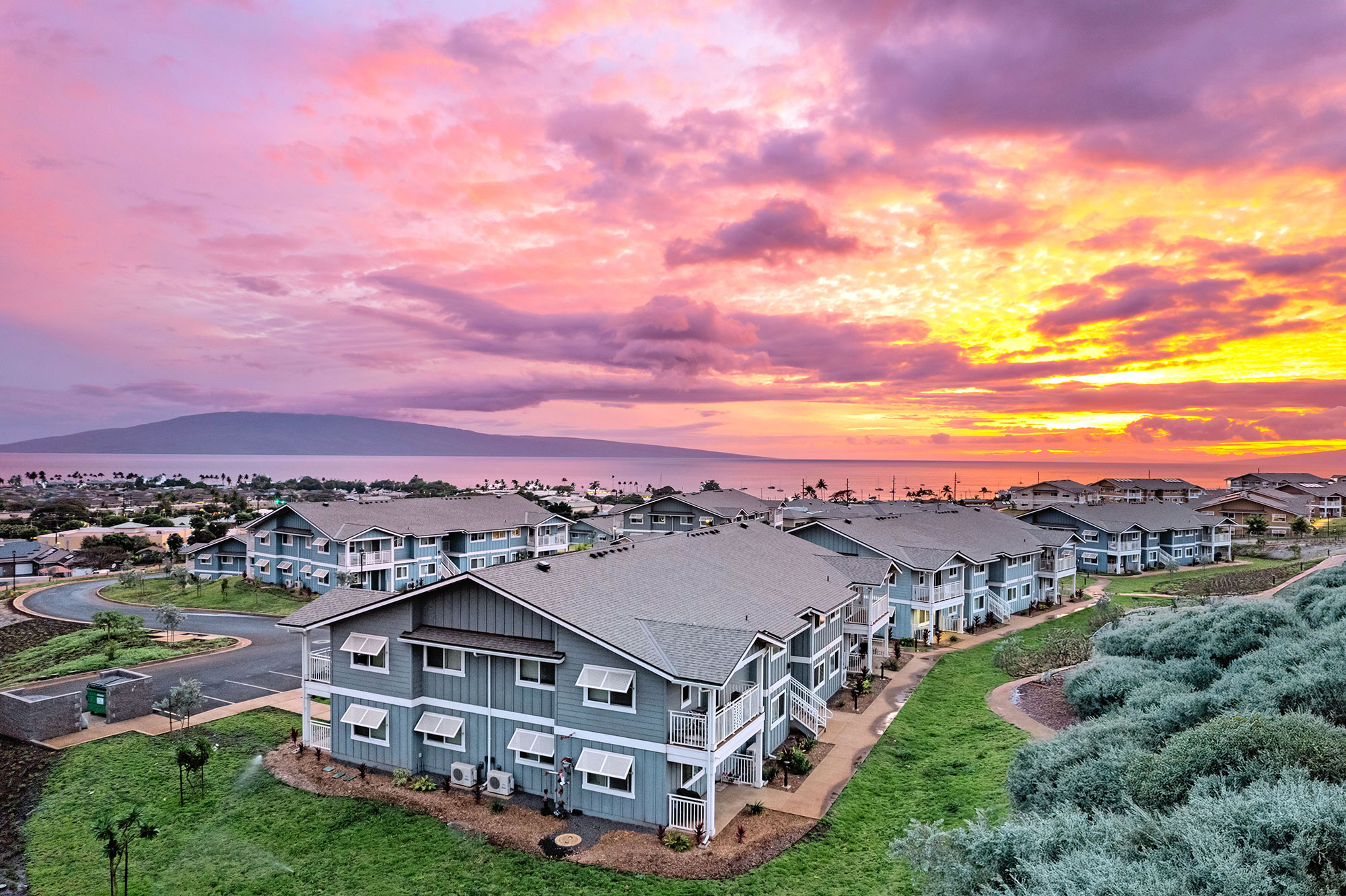
In 2023, the deadliest American wildfire in over a century swept through Lahaina, a historic and tight-knit community on the western edge of the Hawaiian island of Maui. According to the Economic Research Organization at the University of Hawaiʻi (UHERO), the fire displaced at least 5,000 households, with the total Maui population falling by at least 1,000 people in the years since. Additionally, UHERO estimates that nearly $60 million of annual income were lost due to Maui’s fire-related population changes.
Amidst this devastation, one recently completed housing development has provided a bright spot for the area: Kaiāulu o Kūku‘ia, a 200-unit affordable housing development that is Lahaina’s first since the 2023 fire. The development officially opened on October 16.
Searching for Efficiency
Despite the great need, Kaiāulu o Kūkuʻia faced so many challenges that it “may never have happened,” says Douglas Bigley, chief executive officer of Blieu Companies, a California-based developer. Blieu developed Kaiāulu o Kūkuʻia alongside Hawaiian nonprofit Ikaika ʻOhana.
The development had been planned well before fire hit, with groundbreaking occurring on July 19, 2022. This meant that the 28-acre site had already been cleared by the time the fire hit on Aug. 8, 2023, which Bigley says allowed for both a partial fire break that helped save neighboring structures below the site and an easier restart of development post-fire.
Still, the fire caused significant disruption and site damage, requiring major replanning of the development.
One important change was shifting to a phased move-in approach, rather than waiting until the whole project was complete, allowing homes to be provided to families more quickly. This approach achieved helped to achieve the project’s initial goal of beginning family placements by Christmas 2024.
“We had to double our crews to catch up,” Bigley says. “We got back to business faster than everybody else. We moved 88 families in before the holidays.”
To increase efficiencies and facilitate the development, the office of Maui County Mayor Richard Bissen and his staff helped get everything up to speed as soon as possible. “They were very focused on getting people back into permanent housing,” Bigley recounts. “The mayor’s administration allowed us to resume construction immediately and cleared the change to a phased delivery. There was so much will to get it done. We still had delays on the backend, but we were the first to deliver permanent housing in the Lahaina community.”
Bigley says that vertical contractor Maryl Construction and civil construction contractor Goodfellow Brothers provided additional momentum to help house families quickly. “We had the equipment for site work already mobilized in the area,” Bigley recalls. “The minute we said go, we had crews working long hours, multiple disciplines working concurrently, incurring additional costs. But sometimes in life, to be efficient, you have to be inefficient.”
Community Approval
The wildfire was unfortunately not the project’s first setback. For example, given that the project started during the height of the COVID pandemic, supply chain disruptions and staffing issues were a constant, and only magnified by Hawaii’s relative isolation. They also had to deal with rapidly rising interest rates.
The unique and more pressing challenge in Kaiāulu o Kūkuʻia’s early going was the site’s complicated land status, which Bigley says took over a year to navigate. The land on which Kaiāulu o Kūkuʻia sits is designated as “ceded” land, which means that the land belonged to the last Native Hawaiian Queen, Liliʻuokalani, when the islands joined the United States during the end of the 19th century. Today, those lands are reserved for the benefit of Native Hawaiians, similar to how reservation land is reserved for Native Americans in the lower 48 states.
Some development is still allowed on ceded land, and in Kaiāulu o Kūkuʻia’s case, affordable housing is a permitted use. Regardless, Blieu still sought the approval of the local Native Hawaiian community before the developer would proceed.
Though the process added to the project timeline, Kaiāulu o Kūkuʻia eventually received strong local support. “The community really got behind it,” Bigley says. The project was named for a local community member, and many local Native Hawaiian families benefitted from the development.
Capturing the Spirit of ‘Ohana
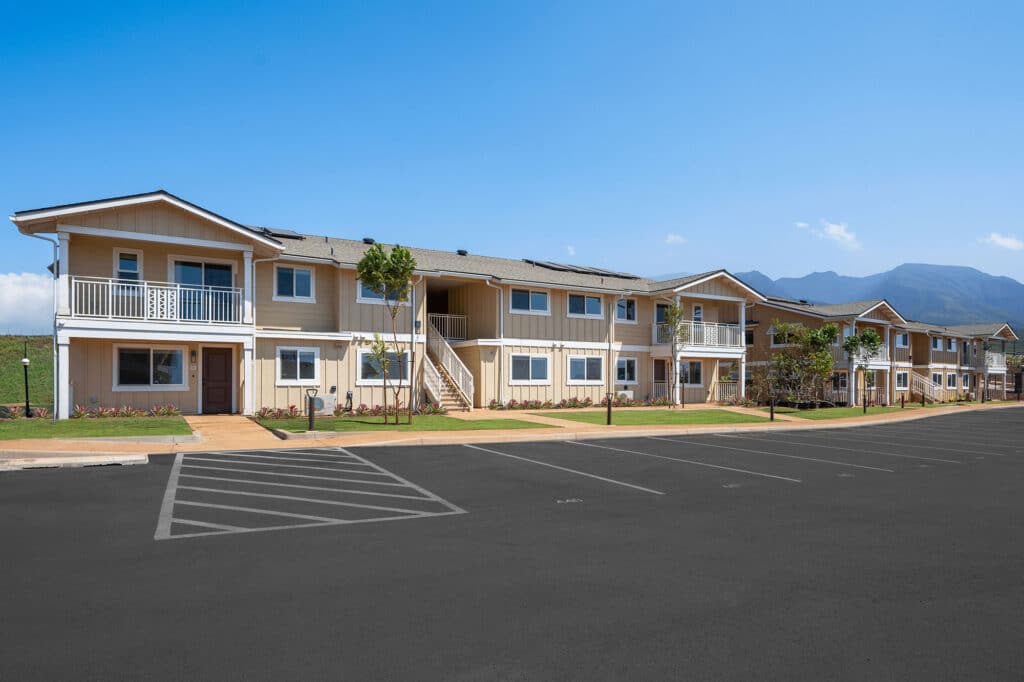
Kaiāulu o Kūku‘ia is laid out across 25 garden-style apartment buildings, creating a walkable, neighborhood-style feel to the development.
In a nod to the Hawaiian cultural tradition of ‘ohana, Kaiāulu o Kūku‘ia deeply emphasizes family-style living. The project offers 100 two-bedroom units, 75 three-bedrooms, and 25 four-bedrooms. Notably no one-bedroom or studio units were built. According to Bigley, this decision was intentional.
“It is well known that Hawaii is losing it workforce, and one contributing factor is that affordable housing often focuses on individuals and small households rather than the large, mutigenerational families that are traditionally part of the culture,” Bigley says. “Because of that, Blieu Companies typically does not build many studios or one-bedroom units.”
In addition to offering larger family-size homes with numerous on-site amenities, Ikaika ‘Ohana has partnered with several local service providers to deliver programming that address health and wellness, education, economic development, and family and senior care.
One of the most notable partnerships is with the Bezos Academy, which now occupies space originally planned for one of the community centers.
Founded by Amazon’s Jeff Bezos, Bezos Academy is a tuition-free preschool that will serve Kaiāulu o Kūku‘ia families and the community with year-round, full-day schooling for 3-5 year olds. Bezos Academy’s 40-seat capacity will help fill a void of about 200 childcare seats that were lost to the 2023 fire, according to Hawaii’s Lieutenant Governor Sylvia Luke. (Coincidentally, Tax Credit Advisor’s other December case study also partnered with a Bezos Academy).
Kaiāulu o Kūku‘ia also includes a large community center and teen center. The community centers will house health and wellness programming, economic development and after school tutoring, among many other services. “The teen center is really phenomenal,” Bigley says. “You don’t see many housing developments that invest in spaces designed specifically for teens.”
Additional amenities include a community kitchen — currently under construction — and a small store which sells incidentals and sundries. There is also artwork throughout the site using local artists.
Of the 200 units, 197 are being offered to families earning between 30 to 60 percent of Area Median Income. Three units are reserved for on-site managers. Kaiāulu o Kūku‘ia is currently fully leased up.
“This is workforce housing,” Bigley says, underlining a concept that is very important to him. “Many of our residents are working families. Hawaii is losing its workforce because people find other places to raise their families where they can afford it and live a better quality of life.”
“We owe the working families,” Bigley says. “They are an economic engine. Residents often ask me why I do what I do, and my answer is always the same: Because you’re worth it.”
Advertisement

Keys to the Deal
Total development cost for the four percent Low Income Housing Tax Credit (LIHTC) deal came to $163 million.
A substantial portion of the capital stack came via public subsidy and concession. “This one started with the state,” Bigley notes. “It was state-owned land. They had 1,000 acres or so. This was the first major development on that acreage. So the state decided they wanted to build affordable housing, and they appropriated $37 million at the state level and put out a Request for Proposals (RFP).” Additionally, land costs for the project are minimal, as the Hawaii Housing Finance and Development Corporation (HHFDC) — who owns the land — issued a 75-year ground lease as part of the RFP.
Kaiāulu o Kūku‘ia “came as a package deal with state funding and the land,” Bigley says. “We won the award, and after that we went back to HHFDC for the bonds and the tax credits.”
Hunt Capital Partners served as Kaiāulu o Kūkuʻia’s syndicator. William Teschke, the firm’s managing director for project management, supplied additional details of the financing.
According to Teschke, bonds were issued by HHFDC. The lender was Bank of Hawaii, who supplied $83,625,000.
$69,710,676 was generated in federal tax credit equity. Additionally, Kaiāulu o Kūkuʻia took advantage of Hawaii’s state tax credit, generating an additional $26,974,090 in state tax credit equity. Hunt Capital Partners assembled a multi-investor pool of banks, life insurers and health insurers, Teschke says.
Additional financing was a $37,000,000 Rental Housing Revolving Fund loan from HHFDC.
