Breaking Ground
Jeremy Bronfman, Founder and CEO of Lincoln Avenue Communities, Industry’s Newest Powerhouse

By Abram Mamet
8 min read

At first glance, Lincoln Avenue Communities (LAC) seems like a typical major player in the affordable housing industry. They have 160 employees, offices on both coasts and in major cities in between, and contribute transformative affordable housing communities to cities across the country.
However, the company has grown at a breathtaking speed, setting them apart in an industry where many developers trace their foundations to the creation of the Low Income Housing Tax Credit (LIHTC) in 1986.
LAC began only ten years ago and has since skyrocketed to the top of the industry. Under the leadership of founder Jeremy Bronfman, LAC has consistently ranked as one of the most active producers of affordable housing in the country over the last few years.
Today, the company owns about 32,000 units across the country, pursuing a mix of innovative methods in new construction and acquisition/rehab projects in order to fuel sustained growth. “Culturally, LAC’s goal is to turn over every stone and see if there’s something we can make work,” Bronfman said during a recent conversation with NH&RA CEO Peter Bell.
Bronfman himself is a relative newcomer to the industry, diving in headfirst when founding Lincoln Avenue in 2016 after an education in public policy and a career in various successful business ventures.
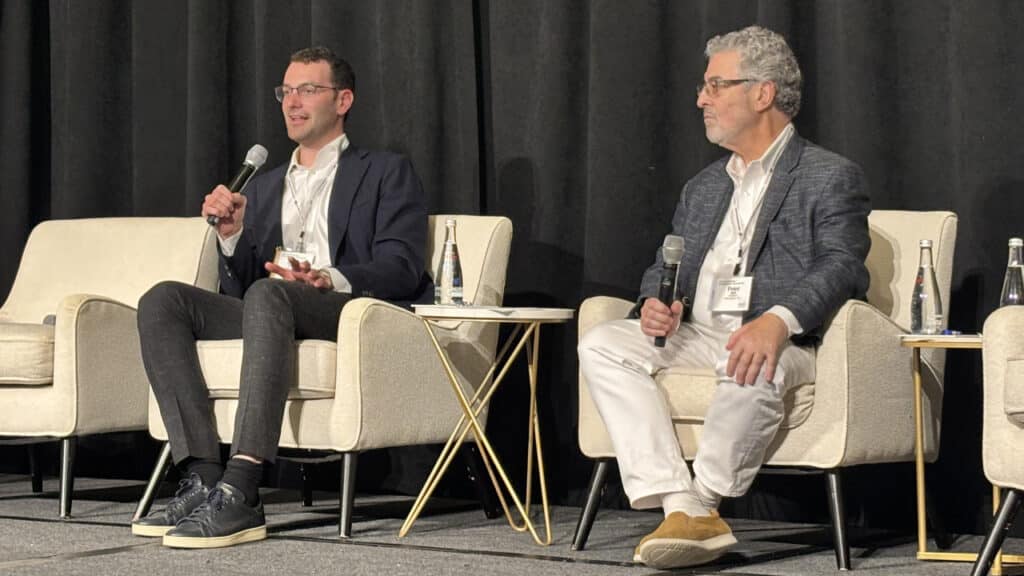
During National Housing & Rehabilitation Association (NH&RA)’s recent Annual Meeting at the bucolic Breakers Resort in Palm Beach, Fla., Bronfman joined Bell in an executive conversation that dug into the methods behind the company’s rapid success.
This interview has been edited for length and clarity.
Peter Bell: Why affordable housing?
Jeremy Bronfman: I love the industry.
I learned about it originally after being solicited to invest in a Year 11 deal by a sponsor who needed capital and was looking to bridge to year 15. After that, I really started studying the industry. The opportunity for impact, the financial complexity, the tax structuring, I found fascinating.
I also thought there was a big opportunity in the market in several ways.
The opportunity we recognized originally was this capital gap at that time, around 2015, of properties that were being sold before Year 15. Most tax credit developers at the time didn’t have traditional equity, and there wasn’t really bridge capital available to buy them.
So, our original thesis was much, much smaller: We thought we’d buy a couple deals a year and build a team that could resyndicate them. And after I started the company and dug in, I just kept finding more and more opportunities and investing back into the business in order to grow.
PB: How is the organization structured? Do you have a centralized operation, or more regional development teams? And where do you find future talent?
JB: This really changed for us in 2019. We were acquiring a lot of properties in 2019, and in 2020, when the big non-traded Real Estate Investment Trusts (REITs) came in and started buying assets at very low cap rates, we weren’t winning any deals.
Advertisement

At that time, rates were super low and interest-only debt was much more accretive, and that doesn’t work in tax credit deals. So we started expanding into new construction from acquisition/rehab deals.
As part of that exploration, I tried to figure out what the right model was to attract exceptional talent on the development side and retain that talent, hopefully for their careers.
We brought on Russ Condas in 2020 to lead our development platform. Russ really helped me develop that model.
What I’m most proud of is the team that we’ve assembled, from the analysts and associates, to the partners. And in a lot of ways, I view my job as creating the circumstances where the development partners at Lincoln Avenue think they have the best resources available to execute on what they’re good at.
We currently have twelve partners. They each have their own region, or specific type of deal execution that they are in charge of. My job is to make sure that all of our resources, whether it’s our capital relationships, or construction management, or origination, or relationships with the housing authority, are excellent.
PB: A question amongst similar companies in this field that have widespread teams: How do you have everybody feel as if they’re a member of the same team?
JB: That’s a great question. On the development team, everybody comes and works in Santa Monica, at least for the first four years. Now, we do have more senior partners that have relocated or are based in the market where they’re focused, but the core junior staff is all based in our headquarters’ office. Santa Monica isn’t the most efficient place from a cost perspective to do that, but it really is important for them to feel like one team.
Even when some of our mid-level development staff goes to work in our regional offices — we have offices in Denver, Minneapolis and New York — we still staff them with other partners, so that there is idea sharing. Because you’re absolutely right: I’m very focused on making sure it feels like one team and not like there’s a Denver team, or a Minneapolis team, or a Santa Monica team.
PB: Along with managing a large, national team, you also manage a large countrywide portfolio. And you don’t do property management — instead, you work with 13 external property managers. How do you successfully manage the managers, and are you exploring consolidating those operations?
JB: There’s no way we could have grown, especially driven by acquisitions in the way that we have, if we had our own management company. I never wanted to be constrained — if we were buying a deal in, say, Reno or Santa Fe, I wanted to make sure we could still do it even though we didn’t have an existing presence there.
One benefit of the third-party model is we actually get to learn from our various managers’ best practices and then share them across our portfolio — they all do certain things better than others. One of the functions of my asset management team is to take what we think is best at each of those management companies and try and scale it. So, one fear I have about doing it ourselves is that that we’d lose some of that diversity of practice.
PB: One of the major topics that’s been dogging the industry is insurance challenges. In particular, owners are facing sustained headwinds on the liability side of the insurance market. How has LAC worked to get their insurance costs under control?
JB: Our insurance rates doubled in 2023, driven in part by our Florida-heavy portfolio. And what became clear to me was that the market has a capital vacuum.
Obviously, climate change has caused increased losses, but we saw the premiums on our lowest layer of insurance, zero to $10 million across the portfolio, go up just as much as the higher levels, which didn’t make any sense, but it was really a capital vacuum in the industry.
We’ve seen over the last three years, the property insurance rates come back down. Liability has been the opposite situation, and that’s really become my message to policy makers: It’s a really bad outcome for the housing industry when a capital vacuum causes insurance rates to double, and therefore you need a lot more subsidy.
In some ways, it’s a little more challenging, because the market has solved itself on the property side, from my perspective, and not at all on the liability side. We’ve seen some success on state-level tort issues, but they take a long time to flow through the system, and it’s a major pain point — we’ve seen effectively redlining against affordable housing.
PB: As an emerging industry leader, what things would you like to see the industry focus on that can help everyone do what they do, better?
JB: One of the things I love about this industry is how collaborative we are. I’m good friends with a lot of my competitors, but I think that’s because overall, we’re aligned. We’re aligned in the mission. We’re aligned with regard to increasing housing. We’re aligned with regard to trying to streamline a bunch of regulatory processes that currently make what we do more challenging and less efficient for creating housing. That’s something that I really enjoy about the culture of the industry.
Advertisement