Reclaiming the ‘Harlem on the Willamette’

By Mark Fogarty
6 min read
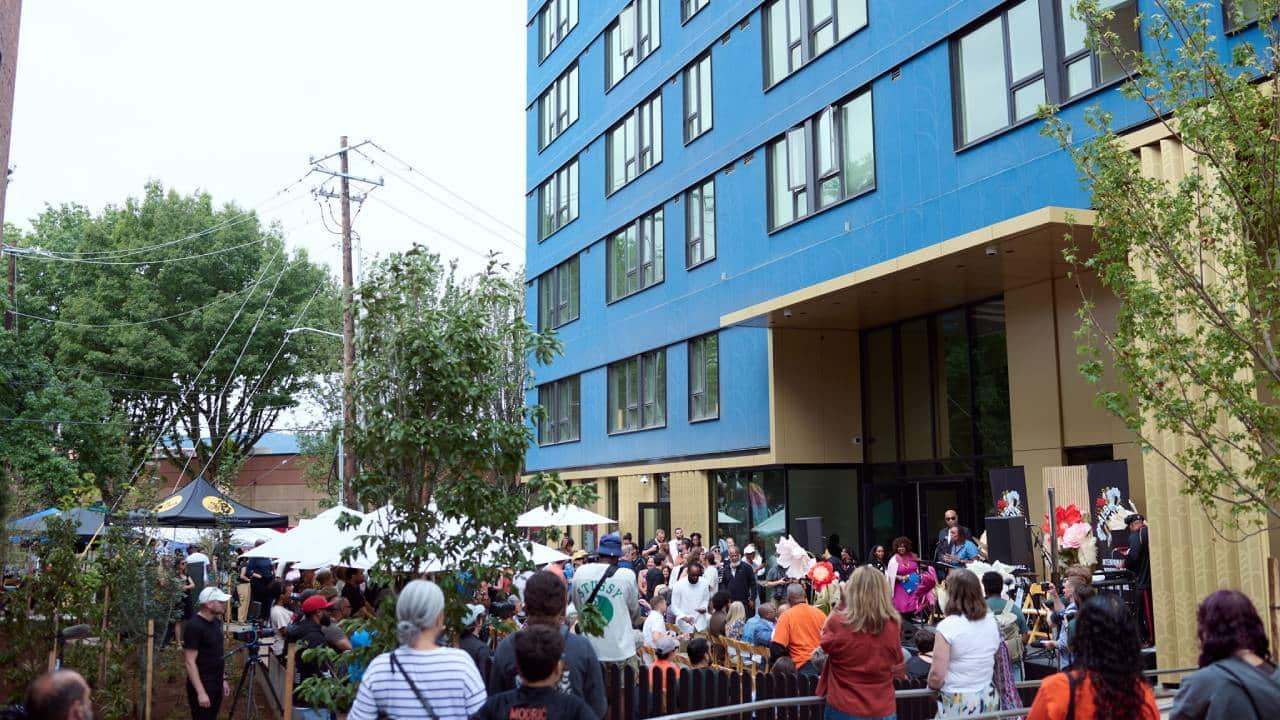
70 years ago, highway building efforts in the Pacific Northwest ripped through the heart of Black Portland. A significant number of residents were displaced, permanently reshaping the Albina neighborhood, then known as the “Harlem on the Willamette.”
Now, a new development — Albina One, which opened September 6 — represents the beginning of a wide-ranging effort to reclaim the vibrant community that once thrived there.
“Jumptown” Goes Quiet
“It’s the same story as in a lot of major cities — people were displaced through [highway] construction and later through a number of urban renewal projects,” says Winta Yohannes, executive director of Albina Vision Trust, a local non-profit that co-developed the property along with Edlen & Company. Between highway building, the construction of Veterans Memorial Coliseum, and the administrative headquarters of the city’s public school system, “there were more than a thousand people who were displaced in a relatively short amount of time,” she says.
The neighborhood was further impacted by the widespread use — and looming threat — of eminent domain, coupled with low appraisals of Albina real estate. More than $1 billion in generational wealth was lost through these actions, according to Carly Harrison, senior vice president of real estate for Albina Vision Trust.
The displacement affected Black people disproportionately. “The neighborhood itself was about 50 to 60 percent Black,” says Yohannes, who points out that the small enclave was a pocket of Black community amidst an overwhelmingly white city. “Albina was the home of four out of five Black Portlanders,” she says.
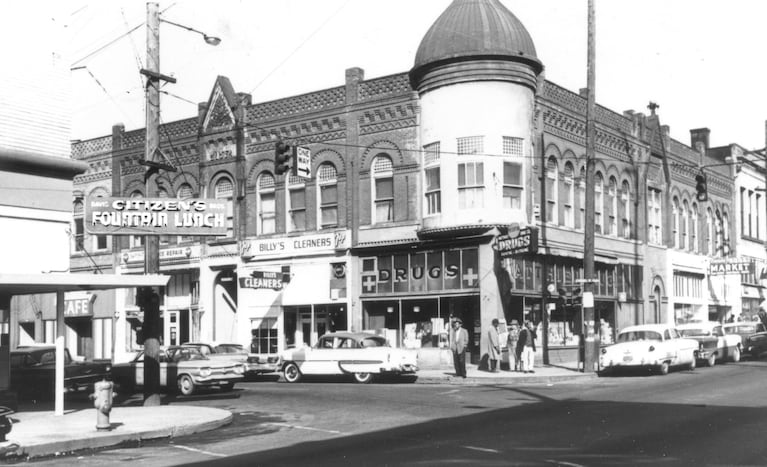
At its heyday, Albina exuded Black culture, with substantial jazz, blues and gospel offerings throughout the ‘40s and ‘50s inspiring the neighborhood’s enduring nickname, “Jumptown.”
“It punched above its weight,” Yohannes says.
However, displacement and disinvestment led to an eventual decline of commercial activity that has not quite recovered. “The legacy of that displacement still has significant impacts,” Yohannes says. Nowadays, “the district is still mostly surface parking lots and major buildings that draw people in at peak times, but otherwise leave the neighborhood vacant.”
Jill Sherman, co-founder of Portland-based Edlen & Co., says that the project was borne of “interest in seeing the property developed in a way that was going to give back to the community, not just be a building.”
Edlen, a for-profit developer, is providing support to Albina Vision Trust, as the non-profit did not formerly have real estate experience. What it does have, according to Sherman, is a deep relationship with the local community “and an unwavering commitment to make the building a standout.”
A Neighborhood Reshaped
Albina One will be the first step in an ambitious plan to put up 1,000 units of housing — both rentals and homeownership units — in an initial phase to reclaim a nearly 100-acre area that has been largely undeveloped for decades. The hope is that at least ten percent of all housing units will be for homeownership, Harrison says. “The more, the better.” No matter the flavor, she stresses that the housing will target working class households. “The Low Income Housing Tax Credit (LIHTC) is a tool we will use for units, either standalone or integrated.”
Residents of the $67 million, 94-unit development will largely be people or relatives of original neighborhood residents displaced when I-5 — the major artery between Portland and Seattle — was built.
Advertisement

Harrison says Albina Vision Trust followed a preference policy for Albina One set by the Portland Housing Bureau. The residential application process “is completely race-blind,” she says. “It uses geography as a means of assigning preference to folks that are interested in housing. If you or your ancestors have close-in ties to Albina, you have a higher score.”
Harrison says the move-in performance so far “is consistent with original demographics. It’s 67 percent Black-identifying folks.” Lease up at the newly-opened building is at about 30 percent so far.
A building next to Albina One, Paramount Apartments, has been purchased by Albina Vision Trust and is currently market-rate housing. The 66 units there will eventually be converted to affordable housing. In keeping with the spirit of Albina One, none of the current residents of Paramount Apartments will be displaced.
After Albina One and Paramount Apartments, the master plan will next have its sights on redeveloping the ten-acre school administrative building site across the street. Harrison says that the larger plan that Albina Vision Trust has for the neighborhood may indeed be the largest restorative redevelopment in the country.
Community-Oriented Impact
In addition to the 94 rentals, Albina One contains 1,000 square feet of commercial space, with plans underway for a food retail space.
The apartments are family-friendly, with 33 two bedrooms and 22 three bedrooms.
“We’re anticipating a lot of kids,” Harrison says. Amenities will include a play area and expanded pedestrian infrastructure. “There’s a large public courtyard and an accessible path to bring people into the area that was cut off by a lot of roads.”
I-5 remains a permanent fixture of the neighborhood, and the highway can be seen from the building. However, thanks to highly efficient windows, “you can’t hear the highway at all,” Harrison says.
So far, Harrison reports that the local community has largely been supportive, and that the Albina redevelopment plans haven’t faced significant NIMBY-ist headwinds.
This may be due to the central focus of the development efforts on community, rather than real estate. “The plan ultimately is to create not only housing but a complete neighborhood where people have what they need to live, work and play,” Yohannes says. “In our master plan we envision a neighborhood with lots of different kinds of housing, with commercial space and lots of open space. The neighborhood is close to the river, and we’re also interested in restoring the connection to the river.”
The grand vision will necessitate a ramping up of staff at Albina Vision Trust, which didn’t have its first employee (Yohannes) until 2020. Today, Albina Vision Trust employs ten people.
The financing of Albina One “was pretty typical for a four percent LIHTC deal in Oregon,” Harrison says.
It started with $14.4 million of Portland Metro bonds. JPMorgan Chase extended a $9.2 million permanent loan and the state contributed $2.1 million from its Housing Trust Fund. Total tax credit equity — a blend of LIHTC, solar, and 45L — came to $27.6 million (Enterprise was the investor). Additionally, Portland contributed $1.87 from its Clean Energy Fund.
Grants in support of the project totaled $2.1 million, and half the value of the land ($1.97 million) was donated. Albina Vision Trust also contributed general partner capital and a deferred developer fee.
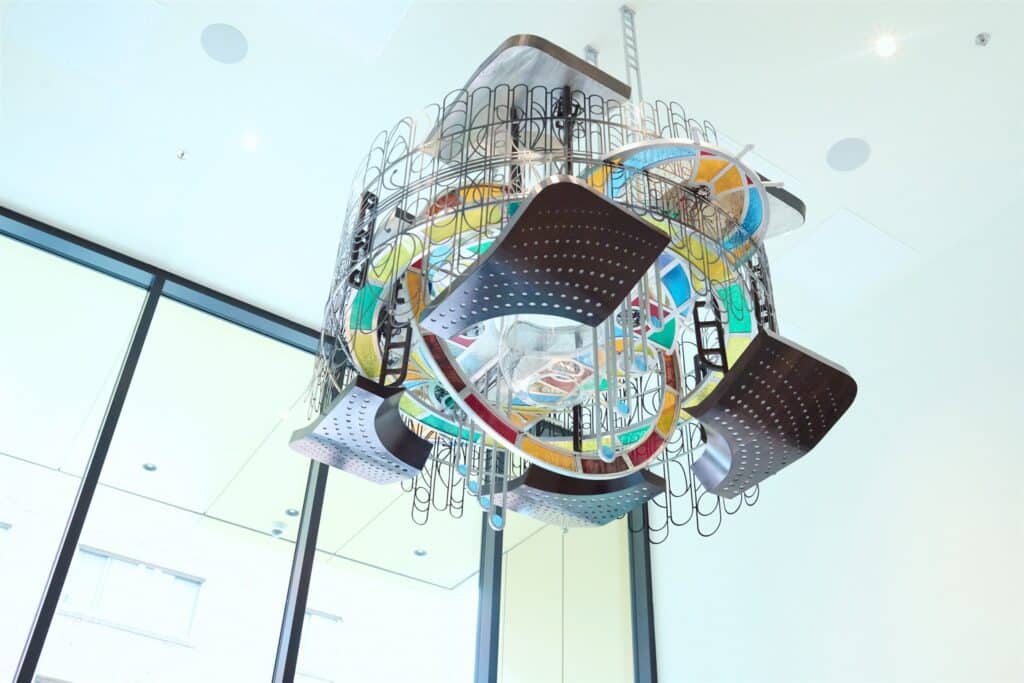
Design of the building leaned into Afrofuturism and Art Deco, Harrison says, leading to bold colors on both the inside and outside of the building, avoiding beige, brown and gray. There is also an Afrofuturist sculpture inside the building.
Altogether, “the most grand thinking possible” has gone into this project, Harrison says. “Thinking that started with community vision, and started with community engagement. There’s been a very clear North Star here from the beginning.”
Advertisement