Can Colorado’s Investments in Modular Housing Factories Close the Affordable Housing Gap?

By Pamela Martineau
7 min read

Despite enduring one of the warmest winters in the state’s history, Colorado’s building community typically experiences two seasons: winter and construction. A combination of biting winds and consistent snowfall make traditional construction in the Centennial State nearly impossible from November-March. This challenge is particularly acute in the state’s numerous mountain communities, contributing to significant regional housing shortages.
However, recent developments in off-site construction have made modular building more practical, creating some hope for a year-round building season in Colorado. To keep up the momentum, state leaders have recently launched two innovative programs aimed at incentivizing modular construction, thereby increasing the state’s overall housing supply and bolstering housing affordability.

“The state has invested over $70 million at this point into the industry,” Hilary Cooper, director of innovative housing for the Colorado Office of Economic Development & International Trade (OEDIT), says of off-site construction. “We have multiple factories that are up and running, producing and focusing on affordable housing. They have been working hard to really understand what it takes to be successful in this industry.”
State Steps Up
Colorado’s primary programs aimed at strengthening modular construction are its Innovative Housing Incentive Program (IHIP) and the Proposition 123 Modular Finance program, the latter being an element of the Colorado Affordable Housing Financing Fund which the Colorado Housing Finance Authority (CHFA) administers for OEDIT.
Across the nation, a major barrier to modular construction has been the lack of available factories, and both initiatives aim to increase modular factory infrastructure in the state.
Proposition 123 — approved by Colorado voters in 2022 — created the Colorado Affordable Housing Financing Fund, providing direct debt financing for the manufacturing of modular and factory-built housing (among numerous other things). Colorado’s IHIP — passed by the General Assembly in 2022 — works similarly, providing both grants and loans to housing manufacturing businesses.
Combined, the programs have already had a noticeable impact in Colorado. According to Cooper, 17 housing manufacturing factories have already been established as a result of these programs; one additional factory will open this spring.
Not all are factories that actually build housing components. Some support developing technologies for housing manufacturing such as 3D printing. Once the factories are fully operational, state officials estimate they will have the capacity to produce about 7,300 units of housing a year.
Nathan Peterson, chief executive officer and founder of Vederra Modular, says his company in March 2025 received about $6 million in loans and lines of credit from the state for the launch of a new factory. Located in Aurora, a sprawling suburb east of Denver, the site is now one of the largest modular factories in Colorado.
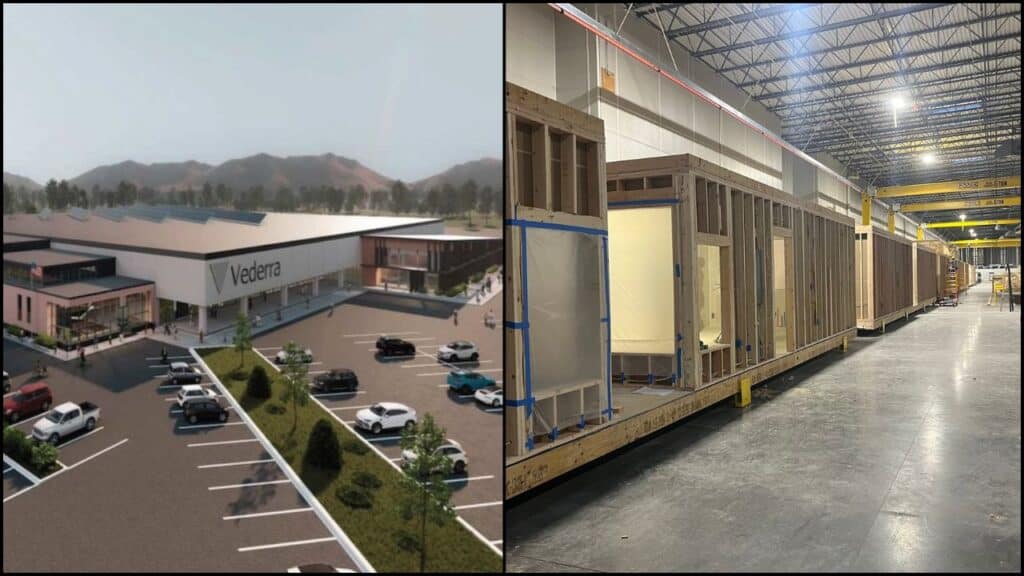
“I don’t think we would have been able to get up and running without that support,” Peterson says. “Five years ago, we had zero modular factories in our state. About 98 percent of our modular housing components came from out-of-state factories.”
In order to further accelerate uptake, Cooper says the state is working to increase demand by offering additional points to projects for using modular technology when applying for competitive OEDIT funds. “We talk to developers all the time about using off-site building technology,” she says. “And we prioritize the use of the technology in our awards to projects.”
Advertisement
Housing Industry Adapts
In addition to its weather-proof building capabilities, off-site modular construction also produces less waste and is safer for workers than building housing outdoors on a worksite. Additionally, construction timelines can often be reduced since the construction site can be readied while the units are being built in factories.
“One of the significant benefits of producing off-site is the efficiency, both in reducing waste and in creating high-quality replicable designs,” Cooper says. “The construction also is being done indoors, in a factory, generally on a single level so it is safer for the workforce. It also offers workforce training.”

Despite the upside, industrialized and offsite construction is still in its “infancy” in the United States, says Jason Van Nest, executive director of the Center for Offsite Construction at the School of Architecture & Design at New York Institute of Technology.
“In almost every other market sector in America, we have embraced industrialization to a much higher maturity level,” Van Nest says. For example, he points to car manufacturing, which for over 100 years has been industrialized, aggregating engineering expertise “so a huge team of very smart people can work on a configuration.” In this manner, “production is centralized and highly controlled and the result is risk managed,” allowing for extremely efficient manufacturing.
On the other end of the spectrum, nearly all housing is engineered to order, which is expensive and time consuming. “Everybody knows on a deep, intuitive level that if we take construction into a controlled factory environment, production should go up and we can build more,” Van Nest says. This will require a “paradigm shift” from many sectors of the economy including “lenders, bankers, marketers, and the workforce.”
One major shift will need to come on the underwriting and procurement side, says Peterson, noting that funding schedules can be different for modular construction when compared with traditional building. For example, deposits for materials for production in a modular factory generally need to be made three or four months before production and delivery, while payments for on-site builds are traditionally made only once they arrive at a job site.

“In this case, materials are not arriving at a job site, they are arriving at a factory,” Peterson explains. “Millions of dollars of materials need to be purchased. You have to figure out the security that the bank needs to make sure they’re comfortable.” In addition to building manufacturing, this means that the industry must adopt new systems in order to maximize the benefits of modular construction. “One of the big challenges with modular is you have these legacy underwriting systems that are built around traditional construction methods and schedules,” he says.
Modular’s Transformative Benefits
Once the industry finds comfort in embracing modular construction, practitioners foresee transformational benefits.
Peterson points to a Low Income Housing Tax Credit project in the rural mountain town of Granby, Colorado, where modular supplied by Vederra will allow developer Summit Homes to provide 68 affordable units to the housing-starved community.
Peterson credits modular’s cost savings as one factor that helped to get the Granby project to pencil, noting that elevated mountain-area building costs, coupled with historically low tax credit equity rates, required savings wherever possible on the deal. According to Peterson, his team was able to lower the project cost by over $2 million.
The $20 million-plus project is still in the design phase, and the team hopes on-site work will begin in June. Enterprise handled the syndication of the tax credits; the syndicators will visit the Vederra factory in March.
Modular’s cost advantage could grow this year as projects begin using grant funding that triggers Build America, Buy America (BABA) requirements. BABA requires that projects receiving federal financial assistance use American iron, steel, manufactured products, and construction materials. Critics say that it will significantly drive up the cost of affordable housing.
Manufactured products, however, face a lower domestic-content threshold than other materials. To qualify, the product must be manufactured in the United States and more than 55 percent of the value of its components must be sourced domestically. Because modular housing units are themselves manufactured products produced in the United States, they can qualify under this 55 percent threshold, Peterson says.
Advertisement