Are Volumetric Water Benefits Affordable Housing’s Next Big Trend?
New Meta-ION Partnership Leverages Corporate Capital to Fuel Water Savings

By Michael Murney
10 min read
A recently announced partnership between ION Water and Meta has the potential to reshape the role affordable housing plays in regional water management.
For years, affordable housing developers have sought effective ways to manage building-wide water consumption. Given that owners are often on the hook for a building’s utilities, Low Income Housing Tax Credit (LIHTC)-supported developments are thus uniquely suited to sitewide water efficiency programs. And, in past years, a host of new property operations technologies have popped up to make managing water consumption easier, increasing sustainability and lowering stubborn utility costs.
Now, water sustainability strategies can pay off even deeper, as some organizations pursue a new, fast-evolving corporate water strategy: Volumetric Water Benefits (VWBs).
Similar to solar or carbon offset credits, VWBs treat verified water conservation in a specific watershed as a claimable outcome, encouraging corporate partners to invest in water efficiency measures.
On January 15, a first-of-its-kind initiative — with potential to scale nationwide — was announced, with tech giant Meta sponsoring deployment of ION’s “End-to-End Water Management System” across all properties owned by a national affordable housing provider within Texas’ Brazos River Watershed (the property owner’s identity has not been publicly disclosed). Over five years, the initiative is expected to conserve 26 million gallons of water.

In return for sponsoring the deployment of ION’s water management system, Meta will be able to claim the water savings, offsetting its own daily usage “so that the community that they’re operating in stays net neutral,” says Eric Homberger, ION Water’s chief commercial officer.
For affordable housing owners and asset managers, the model presents an opportunity to convert comprehensive water management into even deeper savings.
VWBs and VWBA 2.0: the basics
VWBs are part of a broader move by global companies towards addressing shared water challenges beyond their facility fence lines, particularly in the catchments where they operate. (A catchment is an industry-standard term for an area of land where water flows into the same river or lake). The World Resources Institute (WRI) and partners developed Volumetric Water Benefit Accounting (VWBA) in 2019, and released VWBA 2.0 in 2025 as updated guidance for identifying activities, quantifying benefits, and communicating credible water savings claims.

Paul Reig, founder and chief executive officer of Bluerisk, a water management consultant, says the “heart of Volumetric Water Benefit Accounting is a desire to quantify how a project contributes a measurable improvement to the watershed.”
In practice, Reig says, a demand-reduction project should address a known local water challenge. “One of the first things that we’d be looking for in any project is the degree to which that project addresses a known, shared water challenge in a local context.” After that, VWB partners should ask “what fraction of the total cost the corporation is directly contributing to,” since that supports “a clear sense” of attribution back to the sponsor.
VWBA 2.0’s six-step method formalizes those concepts, laying out a discrete framework that sponsors and implementers can use to identify water stewardship activities, quantify resulting VWBs, and communicate claims credibly.
To bring a VWB deal to life, corporations, water consultancies, and water management providers like ION collaborate to work through the VWBA 2.0 framework, including deciding how baselines will be set, how savings will be tracked, and how attribution will be handled. Once a project framework has been audited and verified, ION identifies and secures appropriate affordable housing properties that can produce and benefit from maximum water savings within the established framework.
Fortunately for property operators, the arduous work to create a VWB project has already been completed by the time the developer is tapped for participation, allowing property operators to reap the water and cost saving benefits without putting in upfront time and resources.
Advertisement

VWBs and Affordable Housing
For many housing operators, VWBs are new terminology. For corporations, they are increasingly used to support achievement of publicly stated “water positive” goals. Typical corporate sponsors within VWB partnerships, such as Meta, are searching for water benefit providers within the same watershed of a company-owned data center.
For tech giants such as Meta, water consumption is becoming an increasingly hot-button topic; although measurements vary, some estimates say that American data centers use 200-250 million gallons of water per day. Meta says it aims to be “water positive” by 2030 and has funded “over 40” water restoration projects since 2017, according to the company’s website. Meta is not alone in pursuing water stewardship goals: Google reports a portfolio of water stewardship projects supporting its goal to replenish 120 percent of the freshwater volume it consumes by 2030, and Microsoft has also committed to becoming “water positive” by 2030.
For affordable housing, those commitments matter because they create demand for measurable, basin-relevant projects with clear attribution and durable outcomes.
ION’s pitch makes sense as a unique strategy to further support developers. “Affordable housing is the majority of ION’s business, so there is great alignment to efficiency within the affordable housing market space,” says Homberger.
Water costs are also hard to benchmark, Homberger says, because “there’s over 50,000 water utilities across the United States. And they all bill differently — literally, it’s the Wild West.”

This patchwork utilities landscape can lead to some VWB challenges, since partnerships rely on a perfect match between a corporate sponsor in need of water benefits and an affordable housing provider in need of capital for efficiency projects. “Watersheds are not interconnected — a drop of water saved in Virginia does not equal a drop of water generated for Arizona,” says Mike Johnson, senior director of sustainability at Standard Communities. “VWB partnerships are really oriented around watersheds.”
Thus, water management providers, such as ION, must match a corporate sponsor looking for water volume savings in a specific watershed to properties within that watershed in need of water cost savings.
If a match is found, a sponsor-supported model can function like targeted gap financing for utility management tech, unlocking feasible and rapid implementation of utilities management systems that otherwise might not happen.
The Meta–ION partnership
ION and Meta frame their initiative as watershed protection plus operating savings. The press release cites unit-level monitoring, real-time anomaly detection, and maintenance alerts that can reduce leak-driven waste “by up to 60 percent.”
In a traditional utility management framework, owners get “a bill at the end of the month,” says Homberger. With potentially hundreds of units being represented by a single utility bill, “you have no idea” where a spike may originate from, leaving maintenance teams guessing and inefficient.
ION’s system delivers clear, continuous visibility into water use and invisible leaks by deploying high precision sensors across an entire building, allowing water usage to be monitored on a granular, tenant-by-tenant level. These sensors collect “2,000-plus data points per gallon of water,” says Homberger, sending data to the cloud for analytics and maintenance-facing outputs, he says. This allows building managers to pinpoint leakage issues and over-consumption.
Deployment includes installation, staff training, and a stabilization period, what Homberger calls “hyper care” for the first 30-60 days, followed by ongoing support.
Homberger’s most vivid case for unit-level monitoring centers on “invisible leaks” that do not present as floods but still drive continuous consumption. A toilet stuck open can cause water loss of “3000-5000 gallons of water per day,” he says, while “the normal human should be using about 45 gallons of water per day.” With only “two to three toilets” stuck open, Homberger says, an average building can “more than double” its daily water use.
The goal for efficient water management is not zero leaks, says Homberger — rather, clients should expect reduction, stabilization and predictability of water use and cost. “If you can get to ten percent leak volume across your building, you’re doing really, really well,” he says, noting that many properties enter the platform at “50-60 percent leak volume.”
Currently, the Meta partnership has funded 110 units across two different properties, according to Homberger, with VWBs helping offset water usage of a Meta data center in Temple, Texas.
Corporate VWB programs often rely on multiple partner types. Meta’s published reporting describes projects as implemented with partner organizations and explains that reported benefits may be adjusted to reflect cost-share when projects have multiple funders.
Homberger says VWB measurement begins with a documented baseline. Before ION “ever starts a project,” the company collects “12 months of water bills” to establish prior usage, which “becomes our baseline,” he says. Then, “at the end of every calendar year,” ION compares a rolling 12 months of post-installation use to that baseline, and “the difference between the two becomes the savings that occurred.”
ION’s partnerships with Meta and Standard are just the beginning, the company says, with similar ongoing and planned projects elsewhere in the country. For the industry at large, the initiatives reflect a growing trend among housing providers and conservation-oriented corporations — leveraging VWBs to quantify and track utility reduction, directly benefitting local catchment needs, and providing real cost-savings to owners and tenants.
Advertisement

A Developer’s Perspective
Some developers are already reaping the benefits of VWBs.
Standard Communities, a national affordable housing owner and developer, has partnered with ION for several years on water efficiency solutions. The company reports an estimated halving of utility consumption at properties utilizing the ION system, with typical water usage dropping from 80 to 40 gallons per bedroom, per day. “Being able to quickly and accurately address over-consumption issues in real time — whether it’s a leaky toilet, running faucet, or malfunctioning water heater — allows us to provide high-touch management for our residents while also benefiting from water and sewer savings,” says Mike Johnson, senior director of sustainability at Standard Communities.
However, up-front costs mean that implementing ION’s systems may not always be possible. “Stabilized assets have very thin margins,” Johnson says. “Most of our ION installations were done as part of a LIHTC execution, substantial rehab of the properties,” allowing Standard to incorporate ION’s systems into the budget and scope of the rehab work. However, substantial rehabs generally occur every 15 years at a property, leaving systems vulnerable to hard-to-find leaks for years.
Now, with programs like VWBs, Johnson says owners like Standard can implement water-saving systems years ahead of schedule.
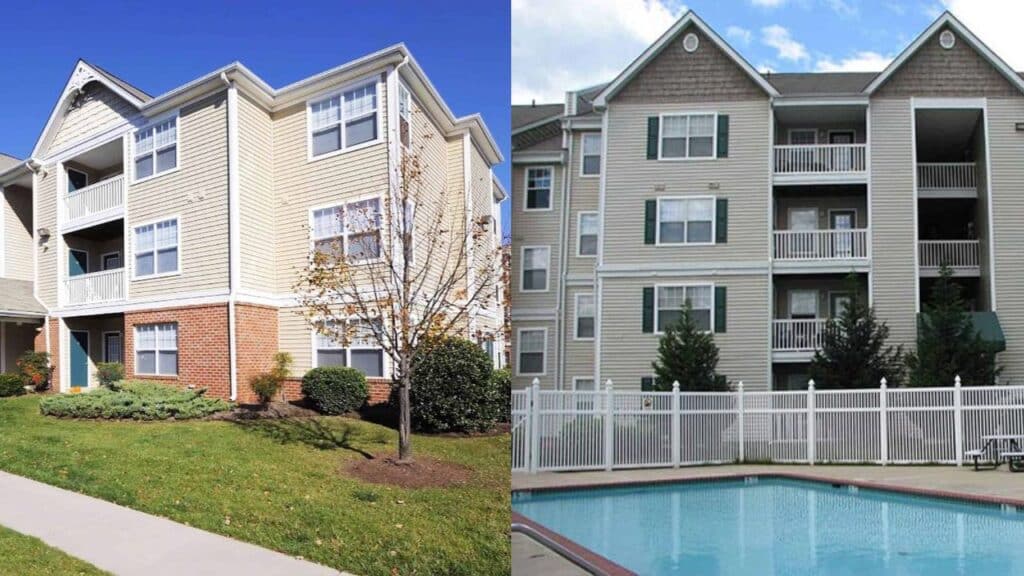
For example, Standard was recently able to enter a VWB partnership in Northern Virginia, allowing the company to install ION’s systems at both The Crossings at Summerland in Woodbridge, Va., and Somerset Pointe in Gainesville, Va.
The VWB partnership was made possible when a corporate sponsor approached ION looking to secure water benefits for a data center in the Potomac watershed. Standard’s two properties fit the bill, so ION approached Standard in late 2024, established a 12-month baseline water usage, and installed their systems in October 2025. The corporate sponsor has not been publicly disclosed
The VWB partnership allowed ION’s systems to be installed across the two properties’ 402 units, all of which are income restricted. Corporate sponsorship of ION’s installation “really was the key to unlocking the long-term benefit of operational savings at the property,” Johnson says, anticipating cumulative annual savings of over $120,000.
