Five Years After George Floyd, Opportunity Crossing Rebuilds with Vision in Minneapolis

By Michael Murney
10 min read
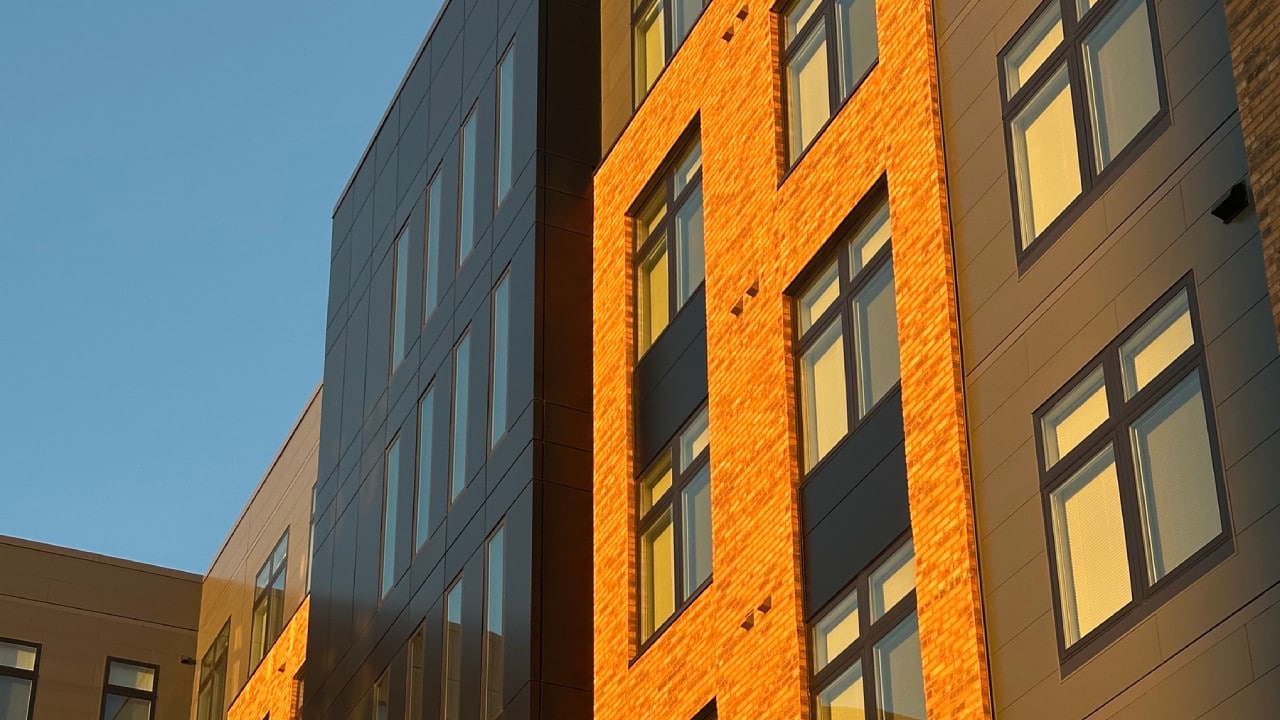
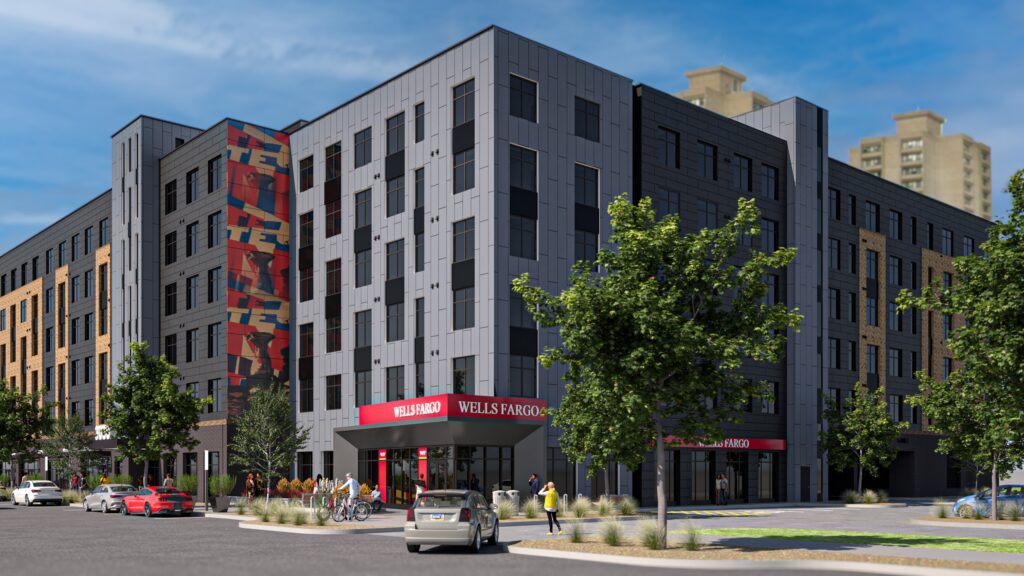
On paper, Opportunity Crossing seems to be a standard redevelopment, converting a formerly vacant site into high-quality affordable housing. However, its deeper structure — both financially and programmatically — serve as a test of what it takes to deliver a complex four percent Low Income Housing Tax Credit (LIHTC) deal on a site that carries deep community trauma, and the operational and political baggage that comes with it. What is now a six-story, 110-unit affordable housing development has risen at 3030 Nicollet Ave. in South Minneapolis, on the same site where a Wells Fargo branch was gutted by fire on May 29, 2020, during unrest after the murder of George Floyd. The branch was later demolished in March 2021.
Now, just four years later, the site has transformed into a community-centered development, opening with initial lease-up in December 2025.
Advertisement

Opportunity Crossing is forward thinking in more ways than one, pairing a family-forward unit mix with an ownership-focused ground-floor commercial strategy and a sustainability package that the development team frames as both a Qualified Allocation Plan (QAP) scoring advantage and a long-term operating-cost play. The project is also a reminder that in today’s four percent environment, closing often depends on stacking soft sources and philanthropy deep enough to bridge the gap.
A Mixed-Use Program Built “With Community”
Project for Pride in Living (PPL), a 50-plus-year old, Twin Cities-based nonprofit, leads Opportunity Crossing, with Wells Fargo as a central partner and future commercial tenant. From the outset, the two organizations focused on intentionally centering residents, beginning with the design process. “How we build is just as important as what we build,” PPL president and chief executive officer Karla Henderson explained in a Wells Fargo-produced project video. “That means: with community.”
William Price, PPL’s senior director for real estate development, places that community process at the center of the deal narrative. “Opportunity Crossing was a kind of collective endeavor with PPL and Wells Fargo,” Price says, describing the project as a response to “a critical site in the heart of South Minneapolis.” He adds that the team is “taking detailed community feedback and providing a project that responds to what the community wanted to see.”
Price says the engagement is not just for show. “That’s one of the cornerstone development modules of PPL: developing with and for the community.”
Price cites partnership with two Minnesota-rooted, holistic-minded firms — the Cultural Wellness Center and project architect Design by Melo — as ways that the development team baked intentionality into the project’s design and programming. “We had many, many on-site conversations with the community to get a sense of what they wanted to see out of this project,” he says.
Fostering Ownership
One unusually direct response to that feedback was to structure the four ground floor retail spaces as “commercial condos,” allowing commercial tenants to own, rather than lease, the space. “One of the key things that came out of those conversations was the want for local businesses not necessarily just to lease their space, but to actually have some ownership and wealth building opportunities,” Price says.
Damaris Melo-Gyasi (Hollingsworth), owner and principal architect of Design by Melo, describes the same community dynamic in blunt terms. During the initial design phase, “we were working with the community for eight months in the summer of 2022, and we came across a lot of conversations that ask the question: ‘Why are we booking out this capitalist rent? Why can’t we own something, especially in the commercial side?’” Melo-Gyasi says.
In response to this feedback, the team built four separate commercial spaces for small-business tenants with the intent to sell, rather than lease, the units.
To find tenants, PPL issued an RFP for entrepreneurs and business owners to apply to purchase a condo unit. Initially, the team had four different tenants: a quinceañera shop, a tax office, Afro Deli (a local restaurant chain), and an incubator/nonprofit training concept. Unfortunately, churn arrived at the worst time. First, the incubator “dropped out right before closing, which was a big problem,” Melo-Gyasi says, delaying PPL’s ability to close the project. “PPL had to be very creative: find another tenant for that space, or another buyer.”
Then a second departure hit. “Very last minute, when we were about to hand it over, the tax office left as well,” Melo-Gyasi says. Fortunately, the team was able to eventually find a replacement tenant while also expanding Afro Deli’s footprint to encompass two of the four commercial spaces.
In addition to tenants of the commercial condos, Opportunity Crossing will also house a Wells Fargo branch, reopening what was formerly “the busiest branch in the state,” according to Price. This further strengthens the project’s long-term performance strategy. “One of the things that really makes the overall commercial performance work is having a solid anchor, such as the Wells Fargo branch,” he says.
A Focus on Family
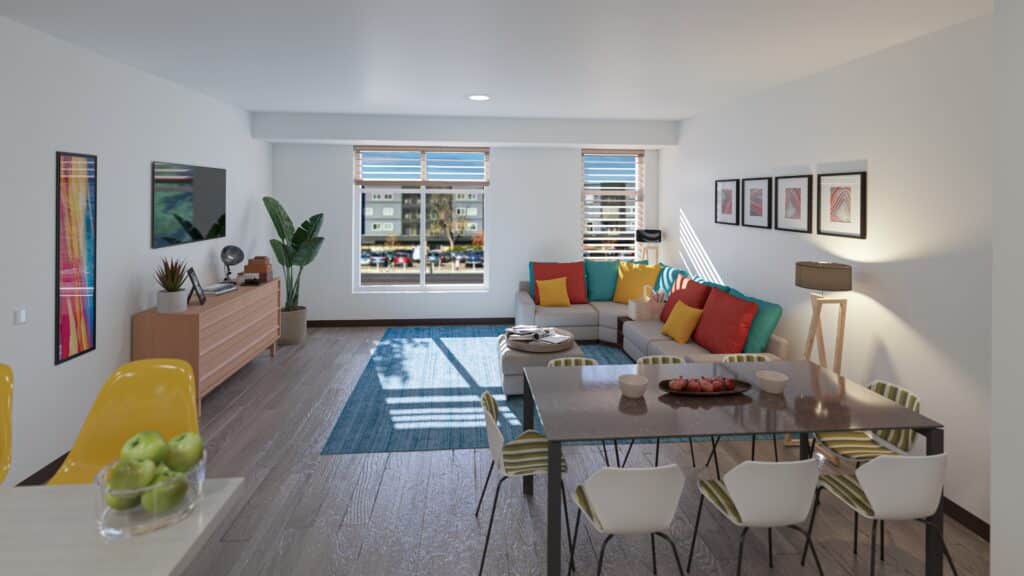
Opportunity Crossing delivers 110 affordable units, and Price emphasizes the high share of larger apartments. The project only contains a handful of small units, with ten one-bedrooms and 15 efficiencies. The other 85 units are positioned to serve families: 55 two-bedrooms, 20 three-bedrooms, and 10 four-bedrooms. “That’s one of the things we’re really excited about: being able to bring some larger affordable units to the marketplace,” Price says.
The six-story, 180,000 square-foot development’s family focus goes beyond the bedrooms, with youth-oriented community spaces, a kids play area, an exercise room, an outdoor plaza and a playground scattered around the site.
Melo-Gyasi frames the large-unit mix as both competitive strategy and operational choice. Minnesota’s LIHTC environment is “very, very competitive,” she says, and scoring pushes teams toward sustainability and family-serving layouts. On planning, she says larger units work best at corners: “A corner is easy to make a very efficient unit. You just need another window for a living room,” she says.
Leveraging Geothermal for “Significant” Savings
Despite federal attempts to neuter green subsidies, sustainability practices have endured in LIHTC developments, and Opportunity Crossing is no exception, with a robust geothermal energy system integrated into the site.
An emerging practice in the United States, geothermal energy systems for multifamily residential tap into shallow earth’s naturally consistent temperature to exchange heat, cooling homes in the summer and warming homes in the winter. Geothermal heat pumps are some of the most efficient HVAC systems available to multifamily buildings, with one 2020 report from Urban Equation finding that multifamily residential buildings enjoyed a 33 percent decrease in annual energy consumption when switching to a geothermal heat pump system from from a traditional 2-pipe fan coil unit HVAC system.
Geothermal energy also seems to have broad support, with geothermal investment credits being one of the few energy efficiency tax credits to remain largely unchanged following passage of the otherwise renewables-averse One Beautiful Bill Act (H.R. 1) earlier last year. This can help defray costs, as geothermal systems have significant upfront costs, lengthening the timeline for returns on investment to manifest. According to the University of Minnesota, federal incentives can help defray upfront costs by 30-50 percent.
For Opportunity Crossing, these benefits meant that “geothermal came in discussion very early in the project,” says Price, due to it’s appeal as “a cost effective and environmentally friendly alternative,” with a “significant reduction in utility costs” for the building and tenants.
Melo-Gyasi adds that geothermal helped Opportunity Crossing to secure the tax credit, providing a “very big jump in our scoring” on the state’s QAP. Though the points boost alone may not have been enough to prove out the steep up front investment for the geothermal system, Melo-Gyasi says that the long-term operating case became obvious for the mission-driven development team. “100 percent of the building is taken care of by the system,” she says.
To build the geothermal component, Opportunity Crossing tapped Darcy Solutions, a University of Minnesota startup that has grown into a leading geothermal provider in the region. The now-completed geothermal system is the first of its kind for an affordable development in Minnesota.
Beyond the geothermal system, the building also includes more traditional green building measures, such as a rain water harvesting system for greywater usage and a rooftop solar array.
Opportunity Becomes Reality
Opportunity Crossing broke ground in June 2024, with construction lasting about 15 months, according to Price. Weis Builders, the general contractor, delivered the project ahead of schedule, and a certificate of occupancy was issued at the end of September 2025, with official move-in beginning in December.
Commercial occupancy is still developing. Price says the Wells Fargo branch is currently targeting early Q2 of this year as an opening date. The other commercial occupants are also still arranging financing, and are expected to move in later. That staggered sequencing underscores a mixed-use reality: residential stabilization and commercial activation can run on different clocks, particularly when the commercial component involves separate ownership financings.
For LIHTC practitioners, Opportunity Crossing is a case study in how a high-visibility site can push a deal toward complexity: layered gap financing, ownership-oriented commercial condos, and sustainability measures that are as much about scoring and operations as they are about mission. If the development meets its utility-performance expectations and the commercial condos stabilize, it offers a template for urban four percent deals seeking to pair deep community engagement with a replicable finance-and-design playbook.
Advertisement

Keys to the Deal
Opportunity Crossing is a four percent LIHTC project supported by additional local dollars. According to Price, the total capital stack included 24 funding sources for the residential side and eight additional sources for the commercial side, underscoring the staggering breadth of layering required to get the deal to pencil.
Total Development Cost was $55 million. An additional $6 million was required for the commercial portion, Price says.
Wells Fargo was a major financial partner for the deal, providing $29.5 million in construction financing, a $24.5 million LIHTC equity investment, and a $6.5 million permanent loan. Full credit pricing and the identity of the syndicator are not yet publicly available.
The rest of the capital stack is made up of a broad coalition of public sources and private gap fillers. “There was a host of various different loans and grants from state of Minnesota, Hennepin County, City of Minneapolis, the Metropolitan Council,” Price says. “Private commitments from Cargill, the Minneapolis Foundation, and Ameriprise were critical to the funding coming together.”
The project also secured dollars from Minnesota’s state tax credit, which utilizes an innovative “donor-based” formula to allow individual state taxpayers to contribute directly to the project in return for a tax credit of up to 85 percent of their contribution’s value.
A full breakdown of the project’s uses and sources, available via Minneapolis’s office of Community Planning and Economic Development shows other highlights, including $3.27 million in housing trust fund dollars, a $1 million deferred developer fee, and $250,000 from Minneapolis’s Neighborhood Revitalization Program.
“There was a collective commitment to fill the capital stack,” Price adds.
Opportunity Crossing makes use of its vast capital stack by targeting deep affordability. 12 of the Opportunity Crossing units are reserved for households exiting homelessness, and are offered at 30 percent Area Median Income (AMI). One unit will be offered to an on-site caretaker; the additional 97 units are reserved for families earning 50 percent AMI or below.
In Minneapolis, this will mean monthly, utility-inclusive rents anywhere from $695 for an efficiency at 30 percent AMI to $1,920 for a four-bedroom at 50 percent AMI, per the City of Minneapolis’s 2025 affordable rent limit schedule.
