Finding Success Through Creativity
Profiling Three of this Year's AHTCC Housing Tax Credit Excellence Honorees

By Pamela Martineau
8 min read
On Oct. 22, the Affordable Housing Tax Credit Coalition (AHTCC) honored ten Low Income Housing Tax Credit (LIHTC) developments with the Recognition of Housing Tax Credit Excellence in honor of Charles L. Edson, feting the projects’ creative design, community impact, and innovative funding.
The honored projects — in eight states and one U.S. territory — included redevelopments of former schools and department stores. All increased housing in underserved communities.
Emily Cadik, chief executive officer of AHTCC, says the projects represent how the “industry continues to evolve.”

“We’re seeing a lot of creativity,” Cadik says, “whether it’s creative financing or creatively meeting a specific need in a community for housing.”
Cadik says the Coalition started the awards several years ago to showcase the success of the LIHTC program for members of Congress.
“We love for members of Congress to see housing tax credit properties in their and other members’ states,” explains Cadik, adding that congressional members are invited to present awards at the annual ceremony. This year, Senators Todd Young (R-IN) and Marsha Blackburn (R-TN) were on hand to discuss the LIHTC program’s continued momentum.
Cadik adds that the LIHTC program is experiencing a “historic level of bipartisan support” after victories secured via the passage of the One Big Beautiful Bill Act (H.R. 1), including both an expansion of nine percent credits and a near-doubling of the country’s potential four percent projects. She says her organization is working on proposals to increase investor demand for the program.
Tax Credit Advisor sat down with three award winners to celebrate the year’s historic achievements, and to better understand what makes a successful project tick.
Patience Pays Off in Anchorage
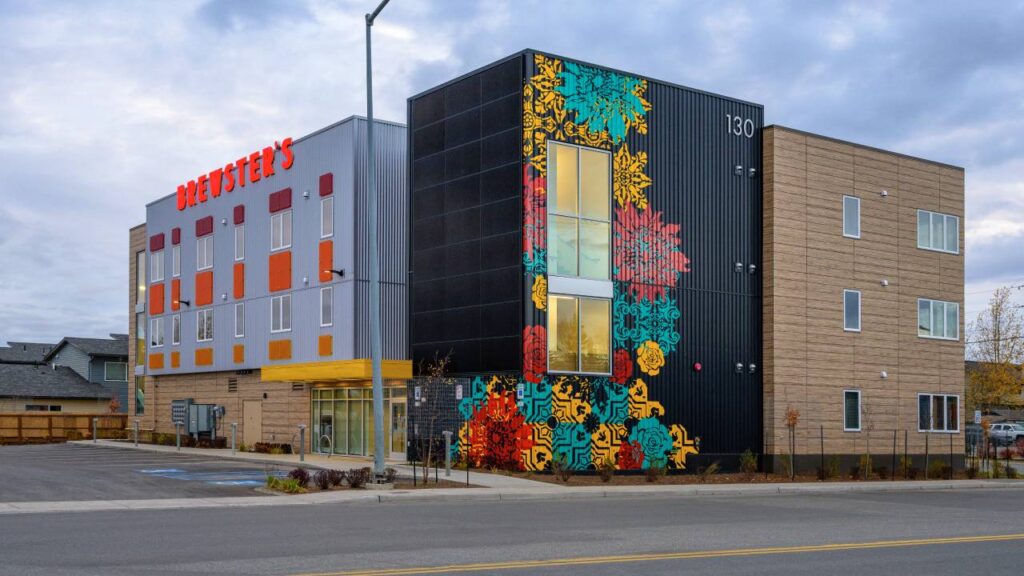
Brewster’s Clothing & Footwear was once the department store in Anchorage, Alaska where people bought their clothing, especially winter clothes. Formerly owned by the entrepreneur Charles Brewster, the department store sported a bright neon sign to reflect the colorful nature of its owner and highlight the store’s presence to the community.
Though the original building was demolished in 2015, the neon sign was preserved and now sits atop a three-story, 21-unit apartment building reserved for residents earning 50 percent of Area Median Income (AMI). Now called Brewster’s Apartments, the project was awarded by AHTCC in the Small Metropolitan Area category.
Cook Inlet Housing Authority (CIHA) was instrumental in redeveloping the former department store, purchasing it following Brewster’s passing in 2003 and initially using it for storage as ideas for its next iteration were brewing.

“A theme for this project is playing the long game with patience and waiting for the stars to align with funding sources and getting the approvals needed to move forward,” explains Mark Fineman, vice president of development at CIHA. Part of the project’s lengthy timeline was the substantial remediation and reconstruction work needed to make the brownfield site suitable for residential use.
The project is in the Anchorage neighborhood of Mountain View, an ethnically diverse neighborhood with the city’s highest concentration of Alaska Natives and low-income residents.
“We decided this was a neighborhood that needed investment,” explains Fineman.
Preference is given to applicants who are formerly homeless, have disabilities, are veterans or Native American. The project is walkable to grocery stores, restaurants, businesses, libraries, parks, schools, and public transportation. The Brewster’s development was a joint effort by CIHA, R4 Capital, Northrim Bank, Alaska Housing Finance Corporation, Municipality of Anchorage, and the Federal Home Loan Bank of Des Moines.
Area demand was strong, and the project was fully leased up just eight weeks after opening. “It speaks to the need for affordable housing in our community, but it also speaks to the type of development we created,” explains Fineman. “We did a lot of listening and then looking at our own data to see what we were missing in our own portfolio and who we should accommodate in our next development.”
Restoring Legacy in Charleston

The Henry P. Archer School in Charleston, South Carolina’s historically underserved Eastside neighborhood was a touchpoint of pride for residents of the community. Shuttered decades ago, people still talk of how impactful the school and its teachers were to the community, explains Kelly Sharkey, director of programs and communications for the Humanities Foundation, which redeveloped the school along with Red Stone Equity Partners.

“It was such a beautiful story what the school had represented to people,” says Sharkey. “It was really important for us when we were taking on the responsibility of restoring it to keep that legacy alive.”
Initially built in 1934, the school served Black students during segregation. After closing in 1980, the building was then used for a variety of purposes, including as a temporary site for other schools undergoing renovation. Eventually, the building became fully abandoned, and was vacant for about ten years when the Humanities Foundation and Red Stone acquired it. It had previously been owned by the Charleston County School District. During its decade of vacancy, it had fallen into disrepair, making the redevelopment more complicated.
Despite the extensive renovation work, “there were definitely elements we were able to keep, which was exciting,” Sharkey says. “We kept the floors in the main building and the exposed brick as well as the overall layout of the school.” This historic renovation was also clearly important to the community, as a previous demolition effort from the Charleston County School District was voted down in 2018 by the local architectural review board.
Because the new owners added two new buildings, they were not able to use historic tax credits for the redevelopment, but did use a local abandoned building tax credit in addition to LIHTC.
Now completed, the project offers 89 affordable homes exclusively for seniors, including 30 units at 30 percent of AMI, 23 at 60 percent, and 36 at 80 percent. A food pantry operated by Humanities Foundation’s Marketplace program provides fresh groceries and meals on site, while residents also benefit from wellness services through a partnership with the University of South Carolina College of Nursing. The redevelopment was made possible with strong support from the City of Charleston and American Rescue Plan Act funding from Charleston County, helping restore a long-vacant school into a vibrant senior community.
Advertisement

The Archer School Apartments was awarded by AHTCC in the Historic Preservation Housing category.
Sharkey advises others who take on redevelopment projects to “prepare for the unexpected.”
“We had so many twists and turns along the way, but we did not give up,” Sharkey says. “We found partners and resources to help us keep moving.”
One unexpected issue was the area’s propensity for flooding. Developers addressed the problem by putting in a high-tech flooding system under the building with holding tanks for water when heavy rains hit.
“Since then, our site is totally dry,” Sharkey reports.
An Adaptive Reuse Jewel in Tennessee
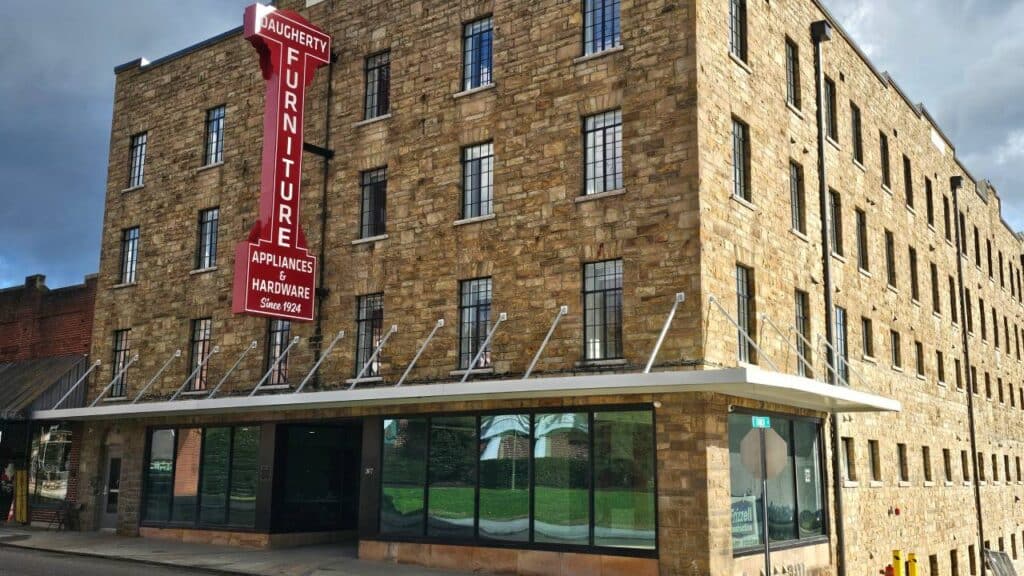
Daugherty Lofts in downtown Clinton, Tennessee is a five-story adaptive reuse redevelopment project that offers 39 one, two, and three-bedroom loft homes, a community room, laundry, and lounge.
The structure, built in 1942, was once the Daugherty Furniture Building, and served as the prime location to supply residents with handcrafted furniture, hardware, flooring, and appliances. Daugherty Lofts retains its historical integrity by preserving unique architectural features which include: original milk doors; a 20th-century stone exterior, which is made of roughly 99,000 pounds of hand-chiseled stone; metal casement windows; a restored fifth-floor skylight; and an original walk-in vault that has been converted into a unit’s laundry room and pantry. The building was listed on the National Register of Historic Places in 2010.
Though a part of the Knoxville metropolitan area, Clinton is sparsely populated, with just over 10,000 residents. Daugherty Lofts was awarded by AHTCC in the Rural Housing category.

Redeveloped by Hickory Creek Capital Partners and syndicated by Hunt Capital Partners, the project was awarded LIHTC credits in March of 2020, just before the country shut down for the COVID pandemic. Subsequent delays and cost overruns due to supply chain issues extended the time it took to complete the project and upped the final price tag from an estimated $12.5 million to $14.2 million.
“We initially closed in March 2020, then the whole landscape shifted,” says Kent Leach, founder of Hickory Creek Capital Partners. “All of the numbers we had were blown to smithereens.”

These challenges — such as when the cost of refurbishing the building’s windows escalated sharply from original estimates — made the project a study in flexibility. William Teschke, managing director, project management for Hunt Capital Partners, says there are often inherent challenges in redeveloping an older building, but overcoming those obstacles is well worth it given the uniqueness of the projects that evolve.
“They can be the most interesting, unique projects,” says Teschke. “They all have their own little quirks, but that adds to the character of the project.”
To make Daugherty Lofts pencil out, partners needed to apply for more LIHTC in 2022. The project received the additional subsidy as well as historic preservation tax credits. In addition to construction and permanent loans, the seller of the project provided a subordinate seller note against the purchase price.
Daugherty Lofts opened in January and “people are loving it,” says Leach. Residents have access to various social services from the Anderson County Community Action Commission, including a weekly food pantry and utility assistance.
“It’s got a lot of character,” Leach says of the project.
Advertisement